


A Portrait of the Artist Reinhard Stammer by Jens Philipp Gründler
“In painting, I feel an energy that simply lets the painting happen. Perhaps it is the force that brought everything into being,” says
Reinhard Stammer, explaining the diverse levels on which his art unfolds. At first glance, this statement seems clear, but if one delves deeper into Stammer’s words, they reveal something mysterious, hard to grasp. Time and again, creatives report that the driving force behind their art is akin to a life energy, an all-encompassing power.
It is these profound, peculiarly touching attempts at explanation, resembling aphorisms, that are also significant in relation to Stammer’s oeuvre. For the interviewee, it may sometimes be difficult to describe his artistic impetus, and yet, one must repeatedly try to uncover the secret of creativity.
So the questioner has no choice but to keep probing, even at the risk of appearing persistent.
What kind of power is at work in Stammer’s art? One is inclined to resort to biographical details to find explanations. However, this approach often proves to be arduous and misleading. Isn’t it wonderful when a work of art doesn’t immediately reveal itself? Can’t we simply appreciate beauty without seeking reasons for it?
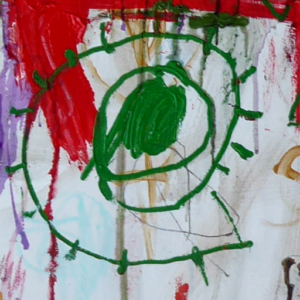
Stammer’s latest works, characterized by abstraction and brightness, appeal directly to the viewer’s soul, evoking serenity and
meditative states. Paintings like “2018?” pictured above, exhibit high aesthetic quality; they are compositions rather than accidental products.
Stammer attributes a humorous worldview to himself in the interview, thereby loosening the often exaggerated interpretive fervor that accompanies art analysis. “No plan, but it’s o.k.,” Stammer calls a painting created this year. Do we believe the artist’s wink?
Are his compositions truly unplanned? Or do the paintings already exist in a kind of Platonic sphere of ideas, complete even before being cast onto canvas or paper? Happy must be the creative who can draw from a wellspring of inspiration without having to strive for it! Stammer’s output, it seems, stems from a flow.
His visual language is unmistakable and marked by high mastery. Even if he denies being a “wise man,” the painter has reached a level effortlessly dominated by naturalness and lightness.
Moreover, the works of the 67-year-old speak a universal language that addresses viewers worldwide. Accordingly, international attention is significant, as Stammer has already showcased his paintings in India, China, London, Saint Petersburg, and Turkey. In New York, too, his lively, touching painting style is appreciated. It seems as if Stammer holds a key that he uses to awaken people’s enthusiasm.
The current works of the artist living in Handewitt, who is opening a new gallery there these days, convey serenity and cheerfulness. In the current phase, his paintings are “free and airy” because he is doing well, says Stammer. Earlier paintings, however, could contain morbid scenarios and evoke a feeling of disturbance in viewers.
Comparing a very early work, such as “Isle of the Dead” from 1970, with today’s works reveals a chasm. One is inclined to attribute the paintings to different creators, and yet they come from one and the same hand. Stammer mentions life crises, a journey through light and shadow, which shapes his opus. Painting saved him, and
over the decades, it has developed in a direction that now prioritizes light.
The painter’s proximity to Far Eastern philosophies and religions helped him free himself from the part of the mind that constantly refers to the ego. Perhaps it is this indeed “wise” act that can be used to fathom why Stammer’s paintings are actually created “unintentionally,” as he says. Despite his intensive engagement with Advaita teachings and Buddhism, he has not been “enlightened.” And yet, mysticism has an influence on his work that should not be underestimated. If one consults the cryptic words of Advaita teacher Ramesh Balsekar, according to whom consciousness is all that is, one may recognize the holistic claim that underlies Stammer’s works, even if the painter would deny it.
The modesty of the Handewitt native is appealing, whose artistic approach must ultimately remain shrouded in mystery, mystical, and inexplicable. The attempt to describe the driving force behind Stammer’s art can therefore be considered a failure. Precisely in this inexplicability, however, springs a source of high artistic enjoyment.
Even if the viewer may not succeed in grasping it with words, Reinhard Stammer’s work stands like a monolith existing since eternity, like a galaxy of its own, whose language was encrypted by its creator. Willingly or not, this form of communication between painter and viewer is accompanied by universality. The dialogue between the work and the receptive eye functions immediately, conveying something of primary importance: aesthetic delight.
The upcoming October issue of “eXperimenta” will be illustrated by Reinhard Stammer.
Jens Philipp Gründler
Short Biography

Born in Bielefeld in 1977, he studied philosophy in Münster, Westphalia. In 2015, the short story collections “Glaspyramide” and “Flüssige Schwerter” as well as the novel “Rebellen des Lichts” were published. Since 2016, he has been working as an editor for the magazine “Experimenta.” Most recently, the collection of narratives “Seelenportal” was published. “Einst gemarterte Heilige,” a novel, and the story collections “Alles steht still” and “Das Schweigen der Gedanken” are currently being prepared for publication.