About Reinhard Stammer

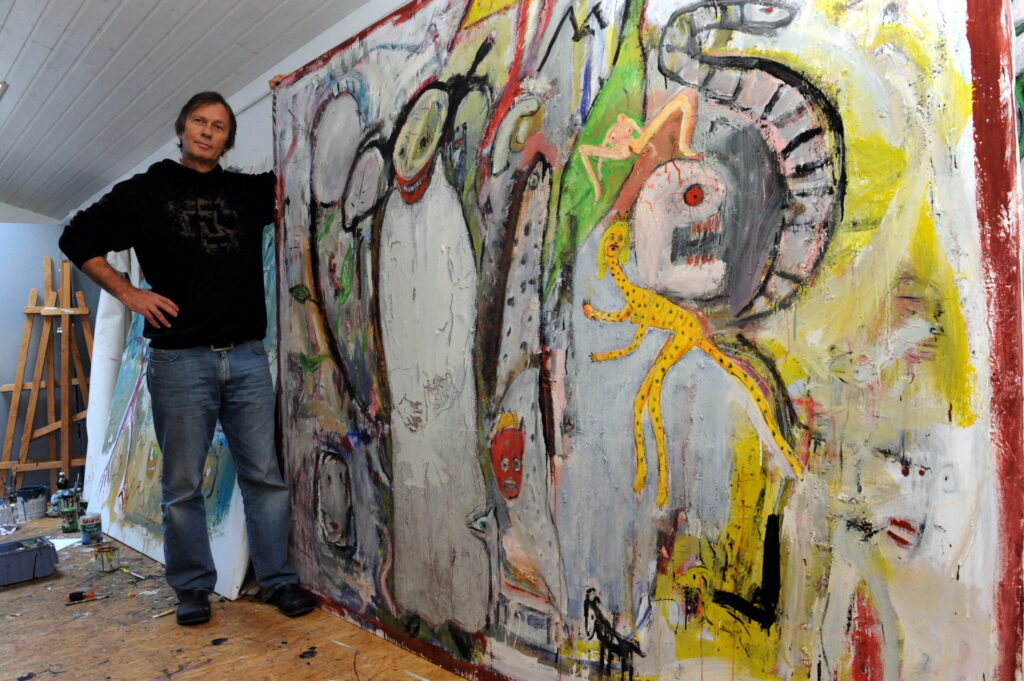
Reinhard Stammer in his studio in front of “Catwoman”
200 × 260 cm · 2011

Art without filter. Emotion as color. “Every line carries the memory of a storm.” Karl Kinsky
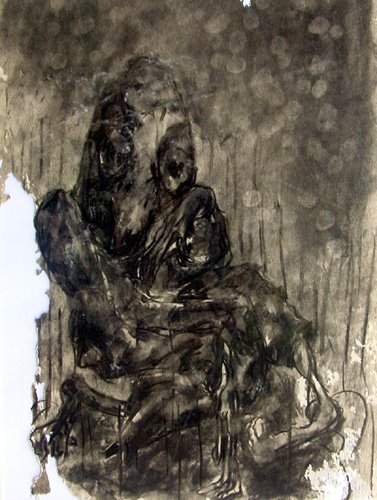
Searching for a sense, made me not look better 40 x 30 cm on paper 1968

Artistic Position – The nature of Reinhard Stammer’s work stands at the threshold between Art Brut and Neo-Expressionism.

What was born from the unconscious as “raw art” in Jean Dubuffet’s time transforms in Stammer’s work into a consciously lived, artistically reflected principle. His painting remains untamed, yet it speaks the language of experience. Stammer does not paint to please or to explain. He paints to survive, to remember, to transform. For him, color becomes emotion, line becomes a trace, surface becomes inner space. His figures, signs, and fragments are like archaeological layers of a soul – remnants of experiences, wounds, insights.

His works preserve the raw authenticity of Art Brut, but they articulate themselves in the gestural, conscious language of contemporary Expressionism. Each canvas is a place of confrontation – between control and chaos, between thought and feeling, between memory and presence. Thus, Stammer creates an oeuvre that is both personal and universal: an archaeology of emotion, a cartography of human existence


Artistic Position – Between Art Brut and Neo-Expressionism

Reinhard Stammer’s art stands at the threshold between Art Brut and Neo-Expressionism. What emerged in Jean Dubuffet’s time as a “raw art” born from the subconscious, becomes in Stammer’s work a consciously lived artistic principle. His paintings remain untamed, yet they speak the language of experience. He does not paint to please or to explain – he paints to survive, to remember, to transform. Colour becomes emotion, line becomes trace, and surface becomes inner space. His figures, symbols, and fragments are like archaeological layers of the soul —remnants of what has been lived, hurt, and understood.
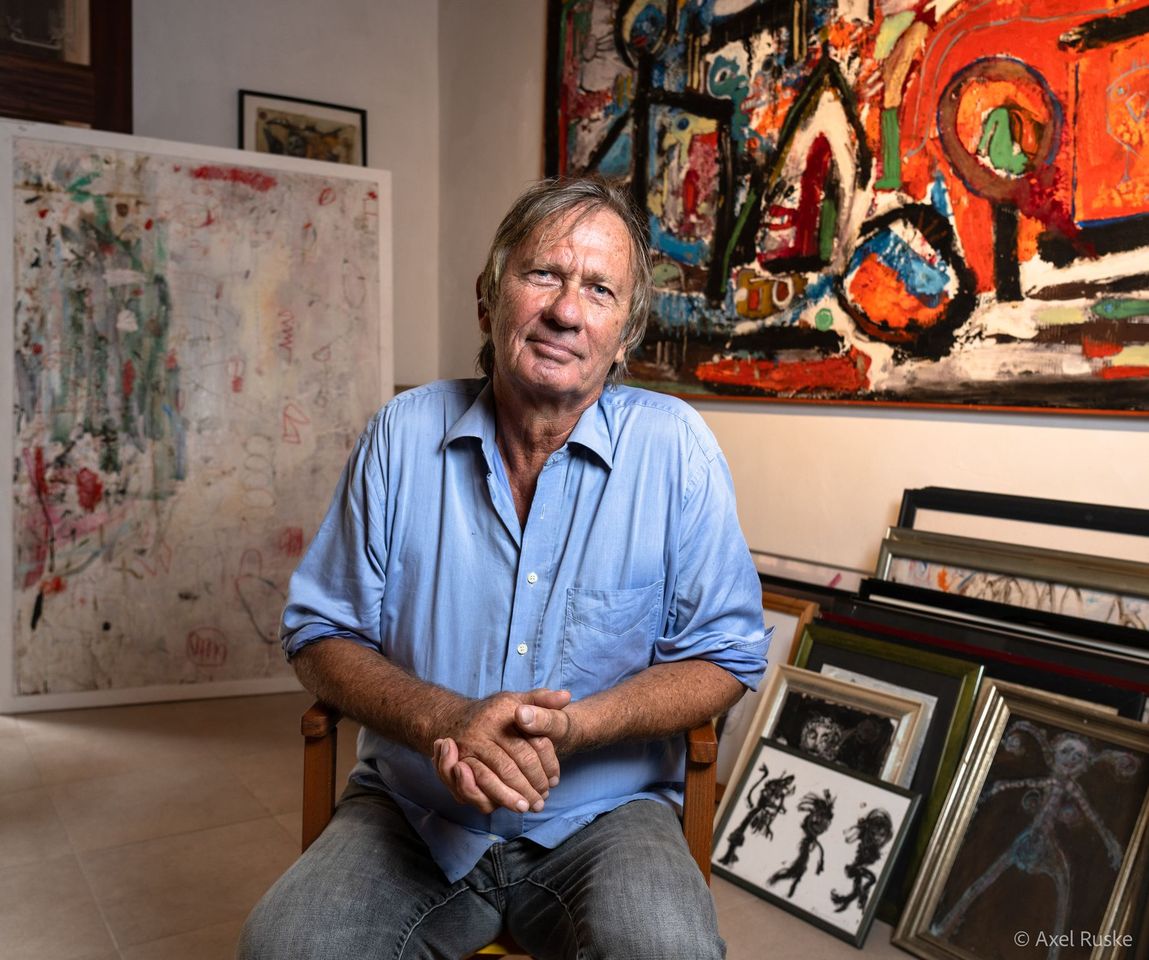
Photo by Axel Ruske
Great Artists of Mallorca by Axel Ruske

Stammer’s works retain the raw authenticity of Art Brut while articulating themselves through the conscious, gestural language of contemporary expressionism. Each canvas is a confrontation between control and chaos, intellect and instinct, memory and presence. His oeuvre is both personal and universal: an archaeology of emotion, a map of the human condition.

Text Karl Kinsky
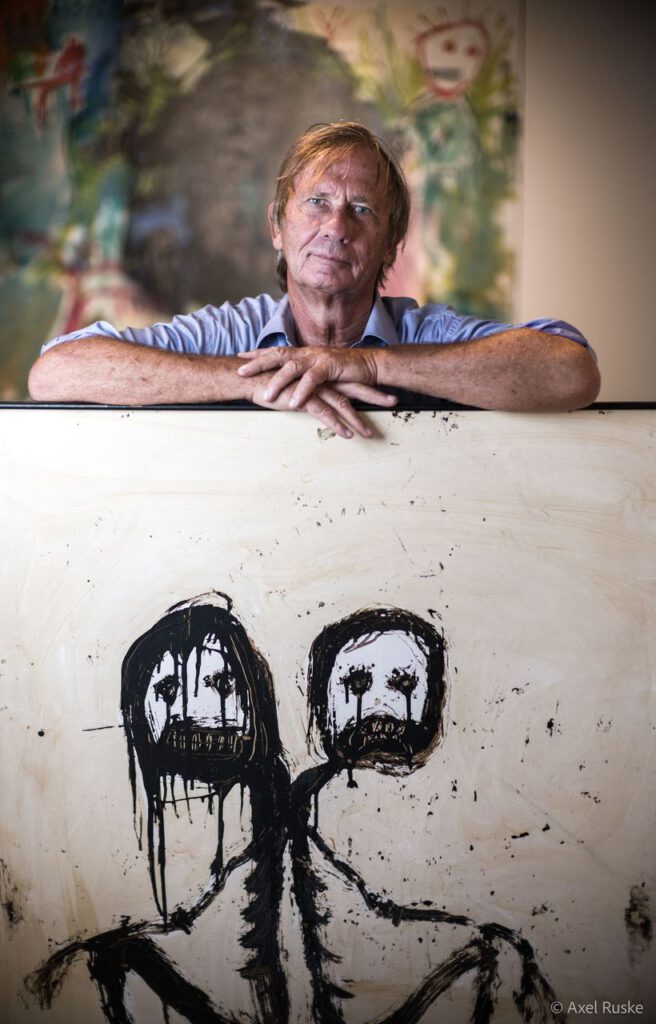
Shoot with AxelRuske for the book “Great Artists of Mallorca”, released in 2025 Concept: Artist portrait and their works. Photo and copyright by Axel Ruske

Short Vita

Reinhard Stammer was born on July 25th 1952 in Glücksburg – close to the Baltic Sea (Germany). He lived a very experimental life with many ups and downs.
The desire to express himself artistically was instilled in him from birth.He wrote many poems and a book that he never published, because he was more focusing on painting. At the age of 33, he founded the P.A.R.C.-Verlag; a publishing house, which he sold at the age of 55 to devote more attention to a life-threatening illness. He began painting more intensively, which certainly helped him to heal from the illness, as also did the treatment of his wife, who, as a successful homeopath, devoted all her knowledge and skills to him. He quickly found galleries at home and abroad that exhibited his highly expressive works. In 2021, at the height of the so called coronavirus pandemic as mandatory vaccination becomes increasingly likely, he and his wife moved to Mallorca. Here he worked together with AT Kinsky in Port d’Andratx . This collaboration found its end in March 2026.
Reinhard Stammer’s art stands at the threshold between Art Brut and Neo-Expressionism. What emerged in Jean Dubuffet’s time as a “raw art” born from the subconscious, becomes in Stammer’s work a consciously lived artistic principle. His paintings remain untamed, yet they speak the language of experience. He does not paint to please or to explain – he paints to survive, to remember, to transform. Colour becomes emotion, line becomes trace, and surface becomes inner space. His figures, symbols, and fragments are like archaeological layers of the soul —remnants of what has been lived, hurt, and understood.

Member of AVAM since 2025

The bold work of Reinhard Stammer by Janis Kirstein

Collector’s Choice: Reinhard Stammer
“The bold works of Reinhard Stammer seem to form a direct stream from his subconscious mind to the canvas surface, assaulting the viewer with the vinegar of turbulent agony and sweet recollections all at once. Many lifetimes of experience and exploration seem poured out into color, line and shape.
Declarations made through textures and emerging shapes require from the viewer the willingness to quietly and slowly decode a multitude of symbols through contemplation, free association and complete immersion in the painterly surface.”

Written by Janis Kirstein

Art Historian Dr. Vöhringer has said: “Reinhard Stammer is, in the best sense of the word, an autodidact.”
The term goes back to the philosophers, aphorisms, writers and poets of Lichtenberg. And it’s good that
there are the self-taught in art, he continues and he calls as an example the painting customs officer
Henri Rousseau.
The well known art critic Uwe Lempelius has said in reference to the work of Mr Stammer, “The fact that art is studied, is no guarantee of the quality of the painted works of art. Only the way that you paint the art is the final guarantee. And this, he says distinguishes the difference between being an artist and being another kind of professional. There are no autodidactic doctors or lawyers, he adds.
“But I know several artists without education who are members of the Federation of Artists. Just think of
the naive customs officer Henri Rousseau whose naive art Picasso once discovered.”
“Yes, now I have included Stammer with these big artists,” Lempelius says. “ Mr.Stammer has given rise to
a whole series of paintings, where if the viewer discovered these works in a museum as an exhibit, he
could not determine if the artist was an amateur.”
Reinhard Stammer was born on July 25, 1952 in Glücksburg on the Baltic Sea.
He says of painting: “The joy of painting, has been with me since I was in the cradle.”
He finds it interesting that symbols found in his pictures from his early youth have re-emerged in his
later works as well.
He says that he studied life with all its ups and downs, with its light and dark sides. “I lived my life
passionately and sometimes excessively. There was no apparent plan. At age 32, I founded the
PARC-Verlag, www.parc.de.”
Stammer’s study of Buddhism and Advaita, along with his many visits to Ramesh Balsekar in Bombay
have been the source of many answers to questions he has asked since early childhood. He believes
that the non-duality or as Ramesh Balsekar says: “consciousness is all there is” seems somehow to be
expressed in his paintings.

As Stammer continued to paint through the years, he increasingly lost interest in merely reproducing
the visible world. A painted flower is not an actual flower, nor a painted man an actual human, he says.
“It is color on a substrate. Nothing more and the colors and shapes call forth the viewer’s own memories.”
Looking back over his many years painting, Stammer evaluates his paintings by saying, “In 30 years, not
very many paintings emerged, but some were particularly beautiful and interesting pictures.”
During this time, he also wrote poems and also a chronicle, which originated in this period.
He also attributes his ability to compensate severe calamities that struck him at the age of 52 years
with his act of painting. He says of painting, “She saved my life, so I am grateful for this gift that enabled me
to give something through my pictures.”
I would like to give special thanks to Reinhard Stammer for allowing me to feature his art work on
KIRSTEINFINEART.
Call to Action: For more informative features on the finest contemporary artists working today, please
subscribe to the KIRSTEINFINEART Blog “Collector’s Choice”

About Janis Kirstein

Janis Kirstein is an American contemporary artist and writer based in Louisville, Kentucky.
Trained in painting and mixed media, her work explores the subconscious through layered textures and symbolic abstraction.
She is the founder of Kirstein Fine Art, where she curates and writes about artists who blur the boundaries between intuition and expression

The Power of Painting

A Portrait of the Artist Reinhard Stammer by Jens Philipp Gründler

“In painting, I feel an energy that simply lets the painting happen. Perhaps it is the force that brought everything into being,” says
Reinhard Stammer, explaining the diverse levels on which his art unfolds. At first glance, this statement seems clear, but if one delves deeper into Stammer’s words, they reveal something mysterious, hard to grasp. Time and again, creatives report that the driving force behind their art is akin to a life energy, an all-encompassing power.
It is these profound, peculiarly touching attempts at explanation, resembling aphorisms, that are also significant in relation to Stammer’s oeuvre. For the interviewee, it may sometimes be difficult to describe his artistic impetus, and yet, one must repeatedly try to uncover the secret of creativity.
So the questioner has no choice but to keep probing, even at the risk of appearing persistent.
What kind of power is at work in Stammer’s art? One is inclined to resort to biographical details to find explanations. However, this approach often proves to be arduous and misleading. Isn’t it wonderful when a work of art doesn’t immediately reveal itself? Can’t we simply appreciate beauty without seeking reasons for it?


Stammer’s latest works, characterized by abstraction and brightness, appeal directly to the viewer’s soul, evoking serenity and
meditative states. Paintings like “2018?” pictured above, exhibit high aesthetic quality; they are compositions rather than accidental products.
Stammer attributes a humorous worldview to himself in the interview, thereby loosening the often exaggerated interpretive fervor that accompanies art analysis. “No plan, but it’s o.k.,” Stammer calls a painting created this year. Do we believe the artist’s wink?
Are his compositions truly unplanned? Or do the paintings already exist in a kind of Platonic sphere of ideas, complete even before being cast onto canvas or paper? Happy must be the creative who can draw from a wellspring of inspiration without having to strive for it! Stammer’s output, it seems, stems from a flow.
His visual language is unmistakable and marked by high mastery. Even if he denies being a “wise man,” the painter has reached a level effortlessly dominated by naturalness and lightness.
Moreover, the works of the 67-year-old speak a universal language that addresses viewers worldwide. Accordingly, international attention is significant, as Stammer has already showcased his paintings in India, China, London, Saint Petersburg, and Turkey. In New York, too, his lively, touching painting style is appreciated. It seems as if Stammer holds a key that he uses to awaken people’s enthusiasm.
The current works of the artist living in Handewitt, who is opening a new gallery there these days, convey serenity and cheerfulness. In the current phase, his paintings are “free and airy” because he is doing well, says Stammer. Earlier paintings, however, could contain morbid scenarios and evoke a feeling of disturbance in viewers.
Comparing a very early work, such as “Isle of the Dead” from 1970, with today’s works reveals a chasm. One is inclined to attribute the paintings to different creators, and yet they come from one and the same hand. Stammer mentions life crises, a journey through light and shadow, which shapes his opus. Painting saved him, and
over the decades, it has developed in a direction that now prioritizes light.
The painter’s proximity to Far Eastern philosophies and religions helped him free himself from the part of the mind that constantly refers to the ego. Perhaps it is this indeed “wise” act that can be used to fathom why Stammer’s paintings are actually created “unintentionally,” as he says. Despite his intensive engagement with Advaita teachings and Buddhism, he has not been “enlightened.” And yet, mysticism has an influence on his work that should not be underestimated. If one consults the cryptic words of Advaita teacher Ramesh Balsekar, according to whom consciousness is all that is, one may recognize the holistic claim that underlies Stammer’s works, even if the painter would deny it.
The modesty of the Handewitt native is appealing, whose artistic approach must ultimately remain shrouded in mystery, mystical, and inexplicable. The attempt to describe the driving force behind Stammer’s art can therefore be considered a failure. Precisely in this inexplicability, however, springs a source of high artistic enjoyment.
Even if the viewer may not succeed in grasping it with words, Reinhard Stammer’s work stands like a monolith existing since eternity, like a galaxy of its own, whose language was encrypted by its creator. Willingly or not, this form of communication between painter and viewer is accompanied by universality. The dialogue between the work and the receptive eye functions immediately, conveying something of primary importance: aesthetic delight.
The upcoming October issue of “eXperimenta” will be illustrated by Reinhard Stammer.

Jens Philipp Gründler
Short Biography

Born in Bielefeld in 1977, he studied philosophy in Münster, Westphalia. In 2015, the short story collections “Glaspyramide” and “Flüssige Schwerter” as well as the novel “Rebellen des Lichts” were published. Since 2016, he has been working as an editor for the magazine “Experimenta.” Most recently, the collection of narratives “Seelenportal” was published. “Einst gemarterte Heilige,” a novel, and the story collections “Alles steht still” and “Das Schweigen der Gedanken” are currently being prepared for publication.